
Natural solutions for crop production
Saponins from Yucca Schidigera and Quillaja Saponaria, as well as zeolite, also have their place in the field: wetting agent, root development, bio-activation and water management in soils.
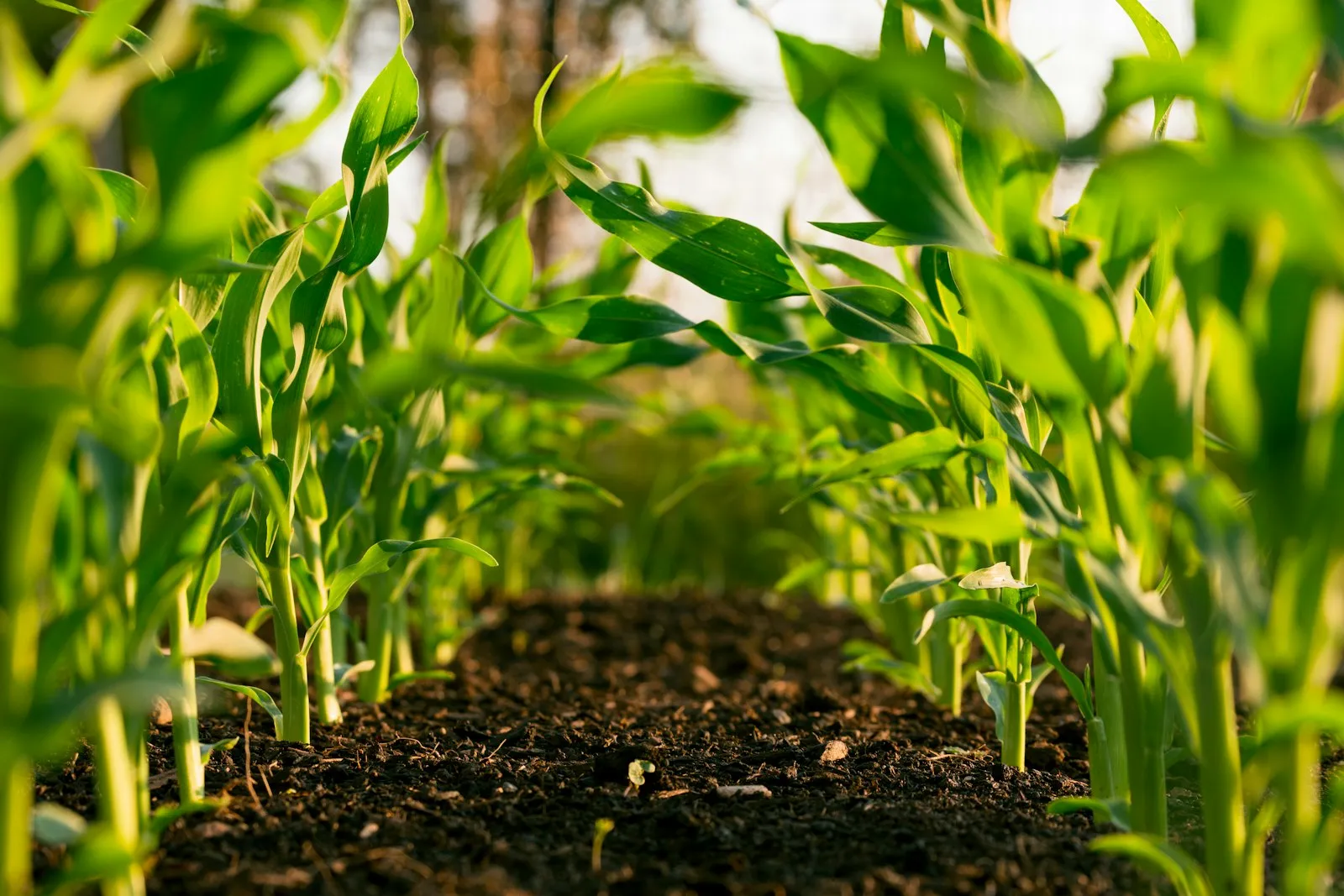
From soil to plant
Note markers [n] refer to the references at the foot of the page.
Wetting agent[1][2]
The surfactant properties of saponins lower the surface tension of water and improve its infiltration into hydrophobic or compacted soils.
Irrigation efficiency[3]
Water that is better distributed in the root zone limits run-off and leaching, for the same amount applied.
Root development
A documented benefit for rooting, emergence and vigour during crop establishment.
Nutrient uptake
By dispersing elements in the soil solution, saponins promote their availability to the plant.
Salt management
Improved water drainage contributes to the leaching of salts in saline or irrigated soils.
Bio-activation & soils[4]
Combined with zeolite, the action supports soil life, water retention and nutrient management.
How saponins work in crop production
Three documented areas of action, from the soil through to crop management. Note markers refer to the references at the foot of the page.
Soil & water
The amphiphilic nature of saponins acts as a natural surfactant: water wets soil particles more evenly and penetrates hard-to-wet dry patches.
Better downward movement of water through the profile and uniform wetting of the root zone, hence better use of the available water capacity.
Plant & root
Consistent moisture around the seed and rootlets promotes uniform emergence and a more developed root system.
Dispersing mineral elements in the soil solution makes it easier for them to reach the roots and be taken up; zeolite helps to retain and release nutrients.
Practices & sustainability
For the same amount applied, better irrigation efficiency reduces waste through run-off and deep percolation.
A plant-based ingredient, consistent with low-input crop management practices and sustainable agriculture.
Our range for agriculture
Yucca Schidigera
Wetting agent, root development, bio-activation.

Quillaja Saponaria
Wetting agent and bio-activator, complementary to yucca.
Klinofeed
Water retention and soil nutrient management.
Scientific literature
- Güçlü-Üstündağ Ö., Mazza G. (2007). Saponins: properties, applications and processing. Critical Reviews in Food Science and Nutrition, 47(3), 231-258.
- Oleszek W., Hamed A. (2010). Saponin-based surfactants. In: Kjellin M., Johansson I. (eds.), Surfactants from Renewable Resources. Wiley, 239-249.
- Kostka S.J. (2000). Amelioration of water repellency in highly managed soils and the enhancement of turfgrass performance through the systematic application of surfactants. Journal of Hydrology, 231-232, 359-368.
- Ramesh K., Reddy D.D. (2011). Zeolites and their potential uses in agriculture. Advances in Agronomy, 113, 219-241.
- Francis G., Kerem Z., Makkar H.P.S., Becker K. (2002). The biological action of saponins in animal systems: a review. British Journal of Nutrition, 88(6), 587-605.
Indicative bibliography drawn from the published literature on saponins, soil surfactants and zeolites, to be checked and completed by Actifeed before publication. No data is presented as an Actifeed trial result; points without a note marker remain to be documented.